
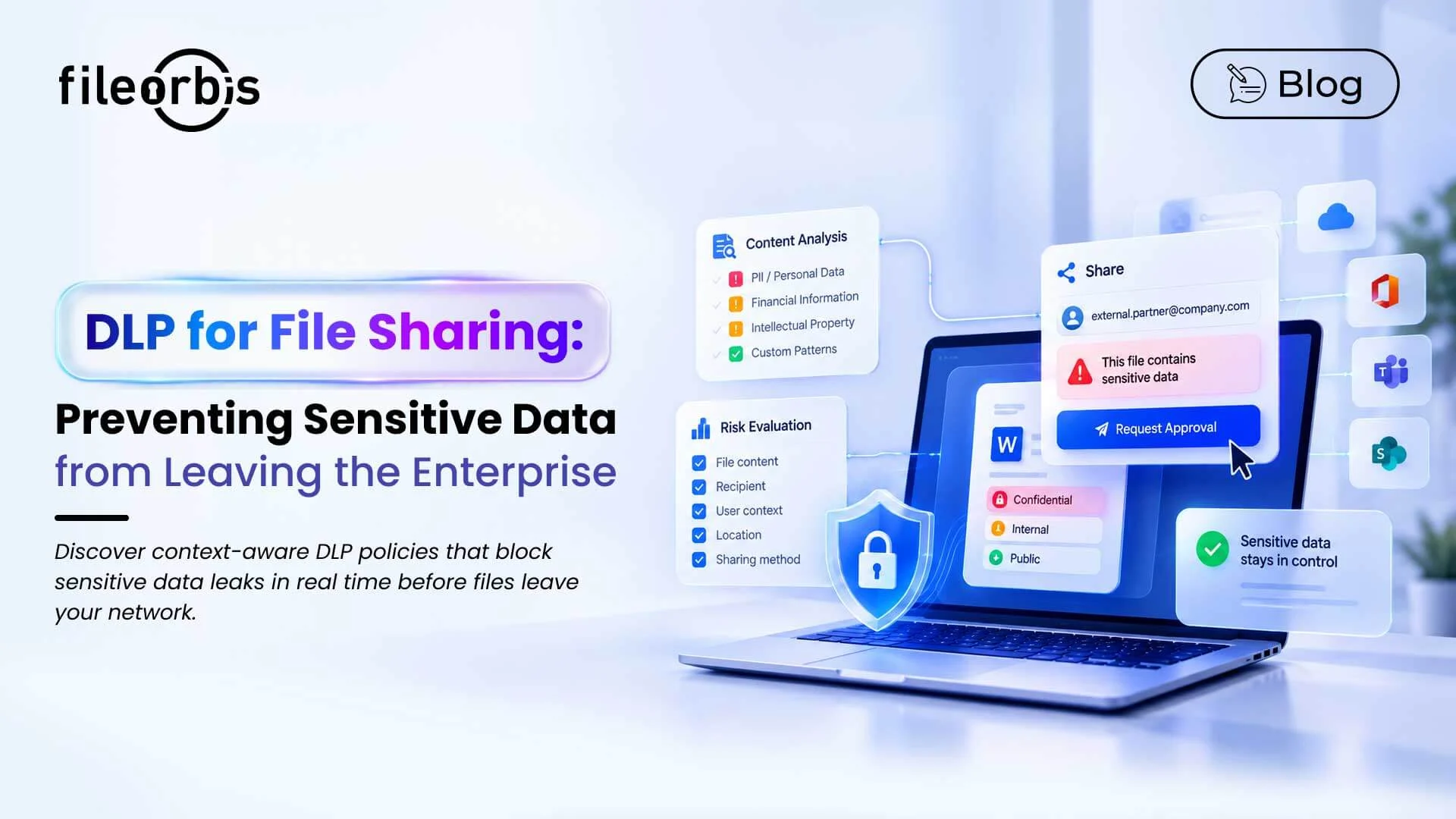
DLP for File Sharing: Preventing Sensitive Data from Leaving the Enterprise
External file sharing is crucial for working with customers, partners, suppliers, and remote teams. However, having access permission to a file doesn’t mean that file should be shared outside the organization.
DLP file sharing adds context-aware security controls to the sharing process. Instead of relying solely on folders, users, or access permissions, organizations can examine what a file contains and apply appropriate policy before sensitive information leaves enterprise control.
What is DLP for File Sharing?
DLP for file sharing enforces Data Loss Prevention policies when users share or send files internally or externally.
A strong approach considers more than just the sharing channel. It takes the following:
- What sensitive information does the file contain
- How is the file classified
- Who is sharing it
- Where is the file being sent
- Who will receive it
- What security policy is being implemented
The aim is not to prevent collaboration, but to make sharing decisions based on real data risk.
Discover and Classify Sensitive Data
An effective DLP (Data Loss Prevention) solution begins with understanding what enterprise files contain.
Organizations may need to identify the following:
Personally identifiable information (PII)
- Financial and payment information
- Contracts and legal documents
- Customer and employee records
- Confidential trade information
- Intellectual property
Classification adds business context to this discovery. For example, files can be categorized as Public, Confidential, Internal, or Restricted.
This context allows security teams to apply different controls based on sensitivity, rather than treating every file the same way.
Inspect Files at the Moment of Sharing
Sensitive data can appear in unexpected places or within improperly classified files. Therefore, relying solely on existing labels can leave gaps.
Real-time review provides another point of control.
When a user attempts to share a file, DLP controls can evaluate the following:
- File content and identified sensitive information
- User or department
- File location
- Existing sensitivity labels
- External recipient or target domain
- Applicable security policy
The system can then determine the appropriate action before the transfer is complete.
For example, FileOrbis Content-Aware Sharing analyzes file content during operations such as uploading, downloading, and editing, and can combine content analysis with existing classification labels.
Apply Risk-Based Policy Actions
DLP file sharing should offer more than just allow or block options.
Depending on the content and context, organizations can:
- Allow sharing
- Inform the user
- Mask sensitive information
- Apply watermark
- Route request for approval
- Restrict file usage
- Block transfer
For example, an internal document might be shared with an approved partner, while a restricted file containing customer information might require approval or be blocked altogether.
This risk-based approach supports secure collaboration without imposing unnecessary restrictions on low-risk files.
Reduce False Positives by Using Context
Overly broad DLP rules can generate too many alerts and disrupt legitimate business processes.
Instead of relying on a single keyword or pattern, organizations can combine multiple signals:
- Content patterns
- User ID or department
- Classification labels
- Recipient
- Destination
- Metadata
- Sharing context
This helps differentiate between legitimate collaboration and truly risky transfers.
As a result, DLP becomes a practical security control rather than a constant source of frustration for the user.
Build Exception and Approval Workflows
Some sensitive files may need to be removed from the organization for valid business reasons.
In these cases, an approval workflow provides controlled exceptions.
- A typical process might include:
- Identifying sensitive content
- Pausing the sharing process
- Redirecting the request to the appropriate owner or manger
- Record the decision
- Approving or rejecting the transfer
Context-aware approval is particularly useful when policies are tied to file sensitivity, recipient, business context, or user role.
Instead of forcing users to bypass security controls, organizations can provide a governed path for legitimate exceptions.
Maintain Auditability
Security teams also need to see what happens after the data sharing decision.
Audit logs should include the following information:
- Who initiated the sharing
- Which file was involved
- Who received the file
- Which enforcement action occurred
- Which policy was triggered
- Was approval required
- Who approved or rejected the request
- When did the event occurred
This information supports investigations, policy improvements, and compliance reporting.
Why DLP Should Be Integrated into the Sharing Experience
DLP becomes less effective when employees must leave their normal workflow and use separate security portals or tools.
Controls should operate where users are already working.
This allows security policies to run in the background while employees continue with their familiar sharing processes. When intervention is needed, the system can inform the user, apply protection, request approval, or block the transaction.
For example, FileOrbis Governance for M365 integrates content-focused security controls into OneDrive and SharePoint workflows, reducing the need for users to switch to separate portals.
How FileOrbis Helps
FileOrbis brings together content awareness, policy enforcement, and secure collaboration in enterprise file environments.
Organizations can use FileOrbis for the following:
- Discovering and classifying sensitive file content
- Combining classification and content signals
- Inspecting content during file operations
- Triggering masking, approval, watermarking, or blocking
- Enforcing context-aware sharing policies
- Controlling external sharing based on destination and context
- Maintaining audit logs for sharing activities
- Integrating with existing security and storage infrastructure
FileOrbis enables data management where it already resides, without the need for data migration, across various environments including file servers, NAS, M365, cloud, and hybrid environments.
In Summary
Effective DLP file sharing should protect sensitive data without unnecessarily hindering legitimate collaboration.
By combining methods such as discovery, classification, context-aware policy enforcement, real-time review, controlled exceptions, and audit logging, businesses can keep external file sharing productive and governed while reducing unauthorized data exposure.

Mert Topaloğlu
Senior Presales Consultant
Subscribe to our Newsletter
About FileOrbis
Aiming to manage the user and file relationship within an institutional framework, FileOrbis is constantly being developed in order to meet different industry and customer needs in terms of file management and sharing. Since 2018, FileOrbis continues to be developed with the excitement of the first day. FileOrbis focuses on high security, rich integration, ease of use and integrated management criteria.