
External File Sharing Approval: How Content-Aware Workflows Reduce Risk
Sharing files with external partners, customers, contractors, and auditors is crucial for business operations. However, not every document should leave the organization without additional review.
A contract might contain confidential business terms. A financial report might contain customer information. An engineering document might expose intellectual property.
Traditional file permissions determine who can access a document, but they do not necessarily determine whether that document is suitable for external distribution.
External file-sharing approval addresses this gap by introducing policy-driven authorization before sensitive information is shared outside the organization.
For enterprises that process regulated or confidential data, effective approval workflows should consider file content, recipient context, classification, and corporate security policies.
What is External File Sharing Approval?
External file-sharing approval is a security process that evaluates whether a file can be shared with an external recipient before granting access permission.
Instead of relying entirely on individual judgment, organizations can establish predefined rules that determine when additional authorization is necessary.
An effective file-sharing authorization process considers several factors:
- File sensitivity: Whether the document contains financial records, personal information, or intellectual property.
- Classification labels: Whether the file is marked as confidential, purposeful, or intended for internal use.
- User permissions: Whether the sender has the appropriate authorization to initiate the transfer.
- Recipient context: Whether the target is an approved partner, guest user, or external contractor.
- Business requirements: Whether the sharing is justified by an approved business activity.
These factors help organizations distinguish routine collaboration from transfers requiring additional security oversight.
Why Traditional File Sharing Permissions Are Not Enough
File access permissions and external sharing authorization serve different purposes.
An employee may legitimately access a customer database export for internal reporting. However, this permission should not automatically authorize sending the same document to an external consultant.
Without additional controls, organizations face several risks:
- Unauthorized external transfers: Internal access rights can be confused with permission to distribute content.
- Accidental data exposure: Employees may unknowingly share files containing sensitive information.
- Inconsistent approval decisions: Different departments may apply different security standards.
- Compliance gaps: External sharing activities may lack the necessary evidence for internal reviews or regulatory audits.
- Limited accountability: Organizations may struggle to determine who authorized a sensitive transfer.
External file sharing approval introduces a separate authorization decision that considers the risks associated with distributing information beyond organizational boundaries.
How an External File Sharing Approval Workflow Works
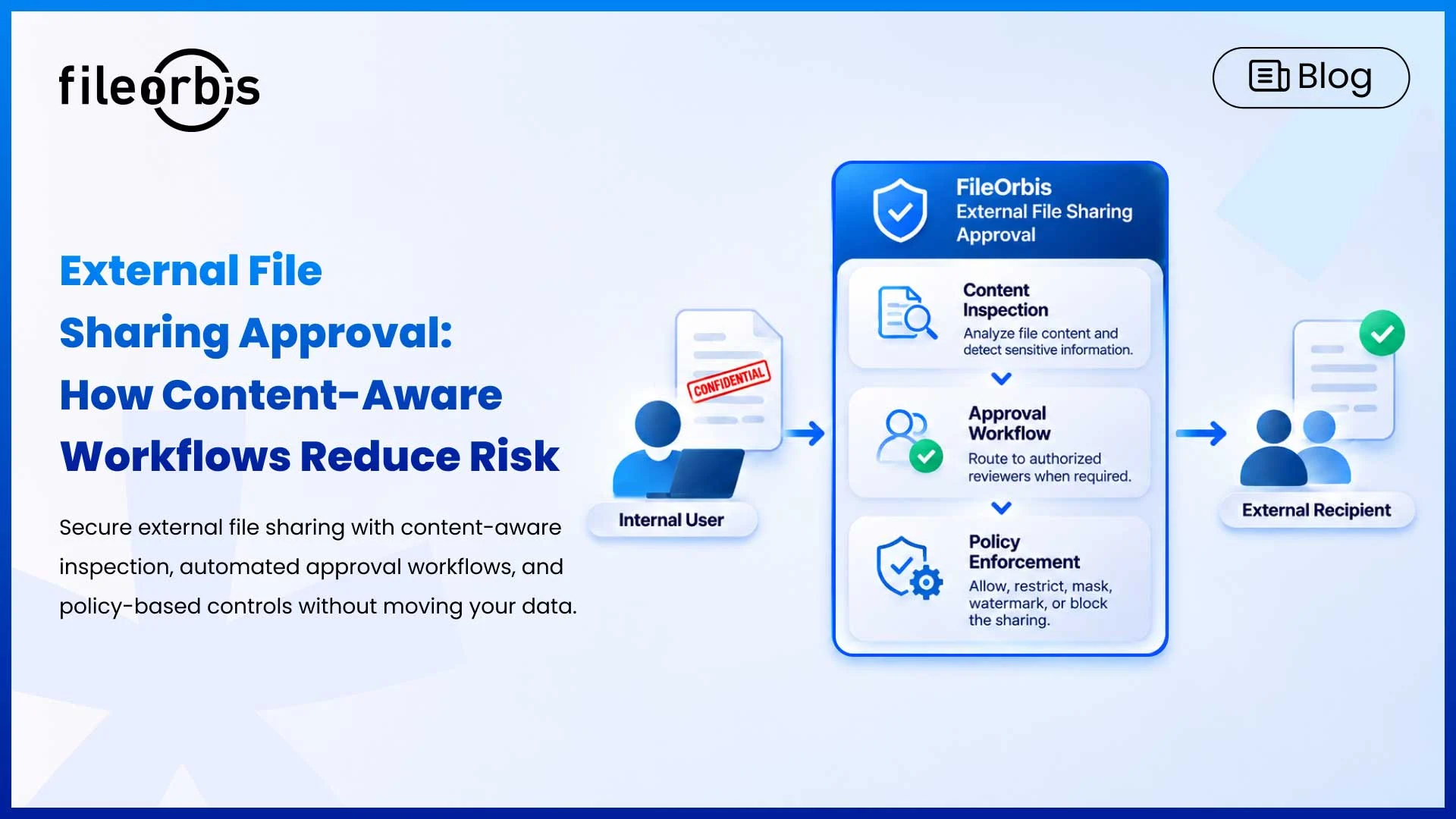
A modern external file sharing approval workflow combines policy evaluation, automated content analysis, and human authorization when necessary.
The process typically follows five stages:
- Sharing Request: An employee initiates an external file sharing request.
- Content Inspection: The system evaluates the file’s content, classification labels, and relevant sharing context.
- Policy Evaluation: Predefined rules determine whether the transfer can proceed, require approval, or should be blocked.
- Authorization and Enforcement: Requests requiring review are routed to designated approvers, and the resulting decision is enforced.
- Audit Log: Approval decisions and related file sharing activities are recorded for accountability.
This approach allows routine transfers to proceed within established policies while directing sensitive cases to authorized reviewers.
The Importance of Content-Aware Approval
Traditional approval processes often rely on static conditions such as file location, department, or document type.
While these controls provide basic oversight, they can miss sensitive information in otherwise ordinary files.
Content-aware approval adds another layer by examining what a document contains.
For example, a spreadsheet stored in a general project folder might contain customer account numbers. A content-aware system can identify this information and trigger an approval workflow even if the file doesn’t have a restrictive classification label.
By connecting approval decisions to the actual file content, organizations can apply more precise security controls without requiring manual review of every transfer.
When Should External File Sharing Require Approval?
Not every external file transfer requires the same level of oversight. Organizations should define approval requirements based on the business context, data sensitivity, and potential risks.
Common scenarios include:
- Human resources: Employee records, personal documents, and payroll information may require HR approval before external distribution.
- Financial services: Customer financial records, confidential statements, and transaction reports may require manager or compliance authorization.
- Healthcare: Patient records and sensitive medical documents may require additional authorization before external sharing.
- Legal departments: Litigation documents, contracts, and privileged information may require review by authorized legal personnel.
- Engineering and R&D: Technical specifications, product designs, and proprietary research may require approval from designated information owners.
These scenarios demonstrate why risk-based approval is more practical than applying identical restrictions to every document.
How FileOrbis Helps
FileOrbis Content Aware Sharing helps organizations protect sensitive information through automated approval workflows and content-aware policies.
Key capabilities include:
- Automated Approval Workflows: Route sensitive sharing requests to authorized reviewers based on file content and classification.
- Content-Aware Inspection: Identify sensitive information and evaluate files against predefined security policies.
- Policy-Based Enforcement: Apply sharing restrictions, watermarking, masking, or blocking when required.
- Secure External Sharing: Control recipient access, expiration, and revocation.
- Audit Log: Monitor sharing activities and approval decisions for visibility and compliance reporting.
FileOrbis integrates with existing file servers, NAS, and hybrid environments, helping enterprises secure external collaboration without migrating their data.
In Summary
External file sharing approval should protect sensitive information without turning collaboration into a manual bottleneck.
By combining content-aware inspection, automated workflows, and risk-based authorization, organizations can reduce unauthorized disclosures while maintaining operational efficiency.
FileOrbis Content Aware Sharing brings these controls into a unified approach, helping enterprises govern sensitive file transfers across their existing infrastructure.

Gamze Mat
Product Manager
Subscribe to our Newsletter
About FileOrbis
Aiming to manage the user and file relationship within an institutional framework, FileOrbis is constantly being developed in order to meet different industry and customer needs in terms of file management and sharing. Since 2018, FileOrbis continues to be developed with the excitement of the first day. FileOrbis focuses on high security, rich integration, ease of use and integrated management criteria.