
File Security Posture Management: From Risk Detection to Remediation
Enterprise files are distributed across file servers, NAS devices, OneDrive, SharePoint, and cloud storage. As these environments expand, monitoring sensitive information becomes more difficult, access permissions accumulate, and security exposures may remain unresolved. File Security Posture Management (FSPM) helps organizations identify sensitive files, assess access risks, and take corrective actions across on-premises, cloud, and hybrid environments.
The goal is not just to detect security issues, but to reduce exposure through continuous and controlled remediation.
What is File Security Posture Management?
File security posture management is the process of evaluating and improving the security of enterprise files based on their content, permissions, exposure risks, and storage location.
Unlike cloud security posture management (CSPM), which focuses on infrastructure configurations, file security posture management (FSPM) addresses risks associated with unstructured files and access controls.
Its core capabilities include:
- Sensitive data discovery: Locate confidential, financial, personal, and business-critical files.
- Permission analysis: detect excessive access rights and inherited permission risks.
- Content classification: Identify information requiring additional protection.
- Risk assessment: Identify files accessible by unauthorized users or overly broad groups.
- Risk remediation: Implement corrective actions to reduce risk.
- Continuous monitoring: Track changes and maintain audit visibility.
Why Traditional File Security Approaches Fall Short
Many organizations rely on manual classification, periodic access reviews, and disparate security tools to protect enterprise files.
However, these approaches struggle to keep pace with expanding repositories and changing user permissions.
Common challenges include:
- Excessive use of permissions: Employees accumulate unnecessary access privileges following role changes.
- Misplaced sensitive content: Confidential documents are stored in inadequately protected locations.
- Dark data: Unused and forgotten files are stored without clear ownership.
- Disconnected remediation: Security findings require manual investigation and corrective action across multiple systems.
These challenges create a gap between identifying and resolving security risks.
How File Security Posture Management Works
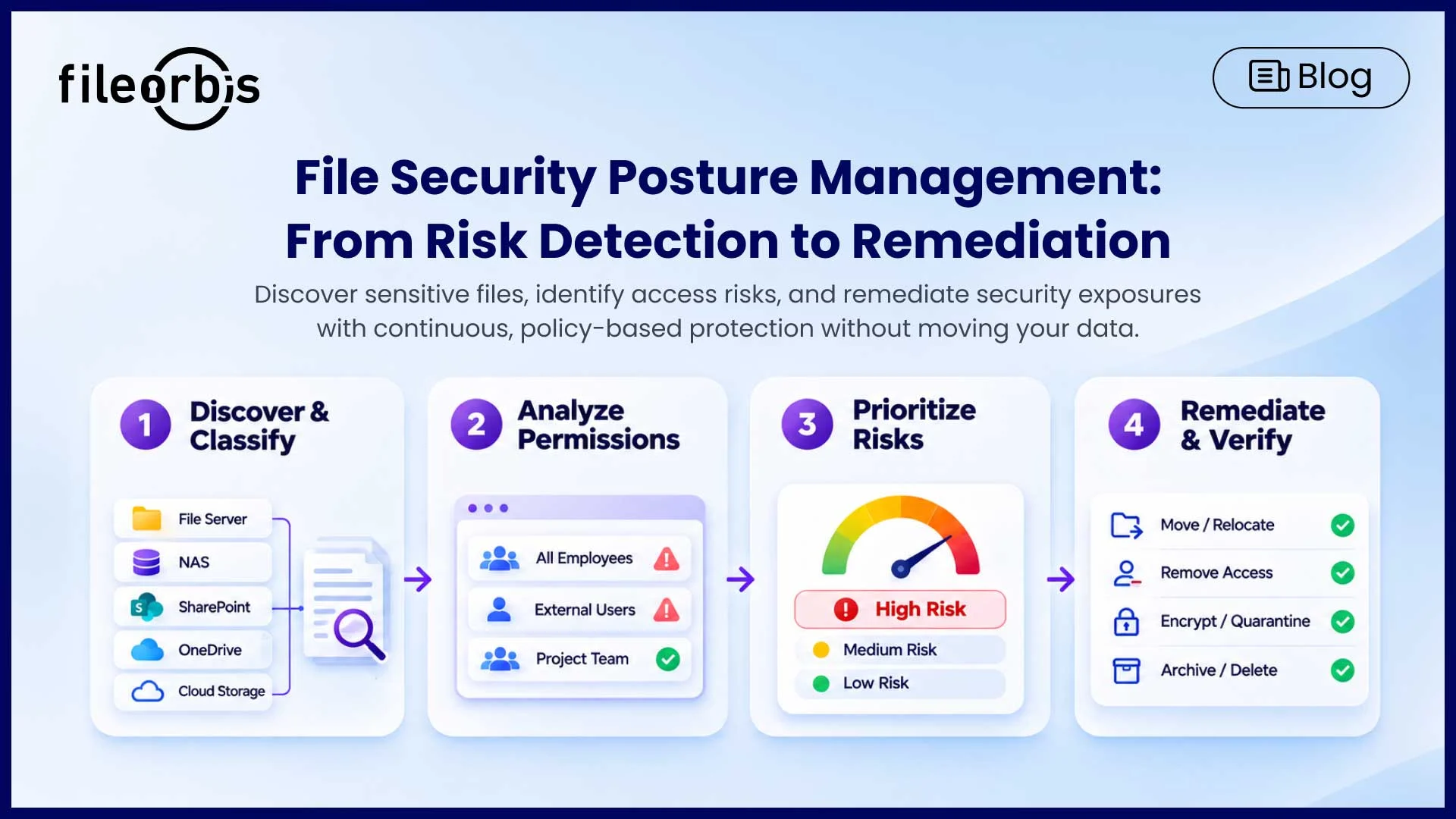
Discovering and Classifying Enterprise Files
Content inspection identifies sensitive information in enterprise repositories. Classification provides the context needed to determine which files require additional protection.
Analyze Access Permissions
Security teams assess who can access sensitive content and whether existing permissions align with business requirements.
This includes identifying overly broad access, outdated user privileges, and inherited permissions.
Prioritizing Exposure Risks
Not every security finding requires immediate action.
Risk-based prioritization considers factors such as access permissions, data sensitivity, sharing activity, and file age to focus remediation efforts on the most significant exposures.
Remediation and Verification
Once risks have been prioritized, organizations can implement the following corrective actions:
- Relocating sensitive files to protected locations.
- Remove unnecessary permissions.
- Revoke outdated access rights.
- Archiving or deleting outdated files according to policy.
- Encrypting or quarantining high-risk content.
Verification and audit records help verify that corrective actions have been completed and support ongoing governance.
How FileOrbis Helps
FileOrbis DSPM Remediate helps organizations move beyond security visibility by combining sensitive data discovery with direct policy-based remediation within their existing file infrastructure.
Instead of requiring organizations to migrate their data, FileOrbis enables security teams to address file-level risks across distributed storage.
Key capabilities include:
- Deep content inspection: Identify sensitive information within enterprise documents and file shares.
- Direct permission remediation: Correct excessive access rights within existing storage environments.
- Contextual risk scoring: Prioritize exposures using sensitivity, permissions, sharing behavior, and data age.
- Controlled workflows: Support approval processes, audit logging, and remediation accountability.
- Policy-based corrective actions: Relocate, quarantine, encrypt, archive, or delete files based on defined requirements.
- Hybrid repository coverage: Extend protection across Windows file servers, NAS, object storage, OneDrive, and SharePoint.
By enabling corrective actions at the file layer, FileOrbis helps security teams reduce exposure without replacing existing storage systems.
In Summary
Effective file security posture management requires a shift from periodic security assessments to continuous risk reduction.
Organizations need to understand where sensitive files reside, determine if access is appropriate, and correct exposures before they become security incidents.
With solutions such as FileOrbis DSPM Remediate, enterprises can turn file security findings into actionable improvements while retaining control over their existing infrastructure.
Learn more about FileOrbis DSPM Remediate.
Frequently Asked Questions
What is the difference between FSPM and DSPM?
FSPM focuses specifically on enterprise files, their contents, permissions, and exposure risks. DSPM covers a broader range of data environments, including structured and unstructured data.
Can file security posture management work without data migration?
Yes. FSPM solutions can analyze permissions, assess sensitive files, and directly address security risks in existing repositories without requiring data migration.
How does FileOrbis help improve file security posture management?
FileOrbis DSPM Remediate helps organizations discover sensitive files, prioritize risks, identify excessive permissions, and apply policy-driven remediations across existing infrastructure without the need for data migration.

Gamze Mat
Product Manager
Subscribe to our Newsletter
About FileOrbis
Aiming to manage the user and file relationship within an institutional framework, FileOrbis is constantly being developed in order to meet different industry and customer needs in terms of file management and sharing. Since 2018, FileOrbis continues to be developed with the excitement of the first day. FileOrbis focuses on high security, rich integration, ease of use and integrated management criteria.