
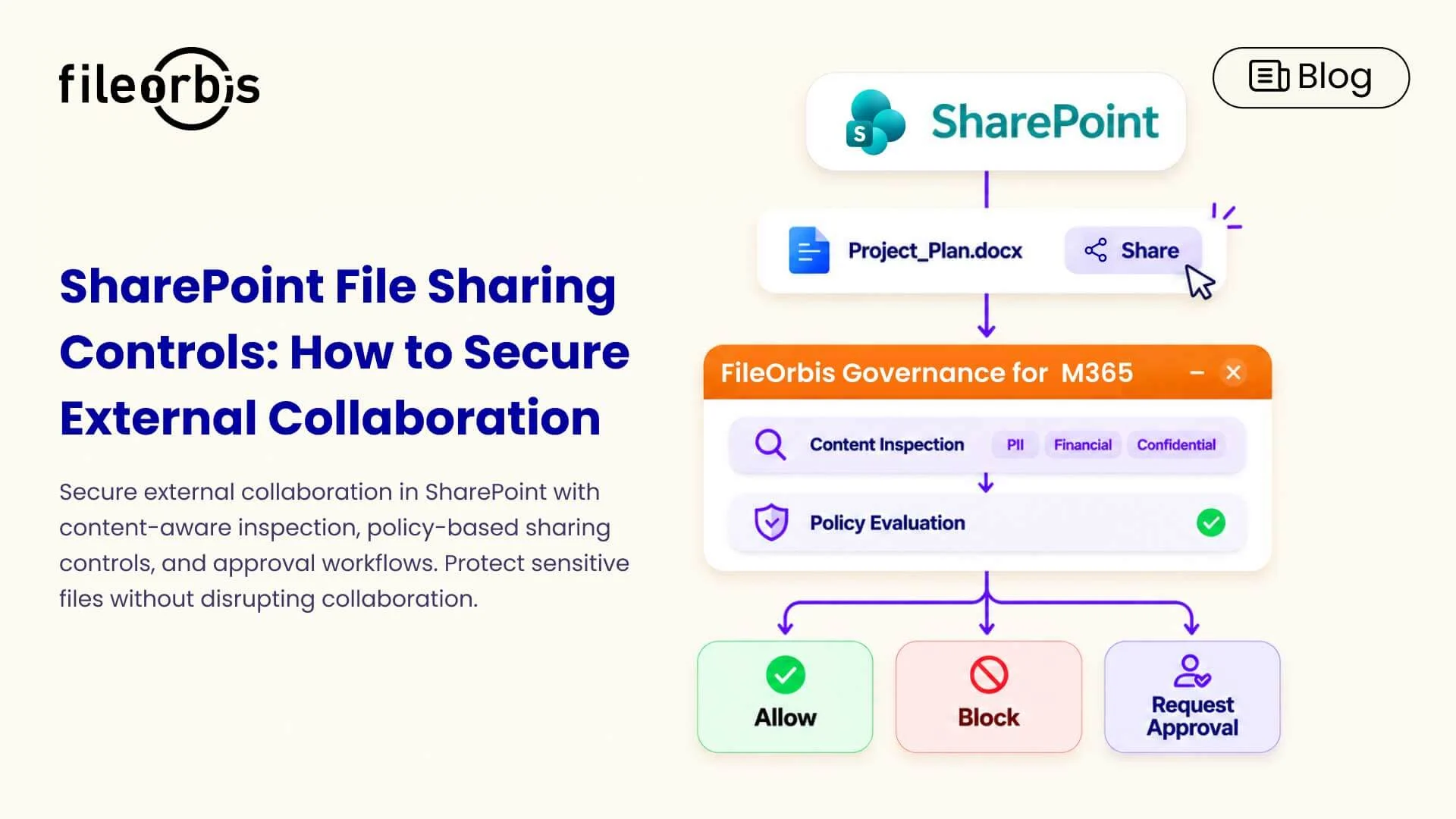
SharePoint File Sharing Controls: How to Secure External Collaboration
Microsoft SharePoint enables organizations to collaborate on documents and share files with external partners. However, as the number of users, permissions, and sharing links increases, managing sensitive information becomes more challenging.
SharePoint file sharing controls help organizations manage external access and document permissions. While M365 provides native security capabilities, businesses may need additional content-aware protection and granular sharing restrictions.
What are SharePoint File Sharing Controls?
SharePoint file sharing controls determine how users can access and share documents stored in SharePoint Online.
These controls operate at the organization, site, folder, library, and file levels.
Key capabilities include:
- Access Permissions: Define whether recipients can view or edit documents.
- External Sharing Settings: Control sharing with authenticated guests, external users, and anonymous link recipients.
- Guest Access Management: Manage collaboration with users outside the organization.
- Link Expiration: Limit the availability of supported sharing links.
- Audit Logging: Monitor sharing activity and support security investigations.
These native capabilities provide a foundation for secure collaboration.
Common Security Risks in SharePoint File Sharing
Without consistent governance, SharePoint file sharing can introduce several security risks:
- Excessive Permissions: Outdated access rights can expose sensitive files.
- Sensitive Data Exposure: Confidential files can be shared without adequate protection.
- Uncontrolled Sharing Links: Links with broad access can reach unintended recipients.
- Inconsistent Security Policies: Different settings across SharePoint and OneDrive can create security gaps.
- Limited Post-Sharing Control: Downloaded files can be redistributed without control.
Addressing these risks requires effective access controls and content-aware sharing policies.
Essential SharePoint File Sharing Controls for Enterprise Security
Managing External Access and Permissions
Excessive permissions and broad-access sharing links can expose confidential information to unauthorized recipients.
Organizations should:
- Restrict anonymous sharing for sensitive sites and libraries.
- Enforce least-privileged access permissions.
- Use authenticated, recipient-specific links for confidential documents.
- Review external guest access regularly.
These practices help reduce unnecessary disclosure without disrupting legitimate collaboration.
Enforce Content-Aware Sharing Policies
Access permissions define who can open a document, but they don’t always account for the information it contains.
Content-sensitive sharing policies help organizations:
- Identify personally identifiable information (PII), confidential documents, and financial records.
- Require approval before sensitive file are shared.
- Restrict external sharing based on content sensitivity.
Organizations can also apply download restrictions, link expiration, watermarking, and IP-based access controls to strengthen protection during external collaboration.
Monitoring File Sharing Activities
Visibility to file sharing activities is essential for identifying unauthorized access and supporting compliance requirements.
Organizations should monitor:
- Who shared or accessed a document.
- When files were viewed or downloaded.
- Which external recipients received access.
- Whether security policies or consent requirements were triggered.
Audit trails help security teams investigate incidents and assess the effectiveness of sharing policies.
How FileOrbis Helps
FileOrbis Governance for M365 extends native SharePoint file-sharing controls with content-aware security, policy enforcement, and advanced protection for external collaboration.
Integrated into SharePoint Online and OneDrive through familiar right-click workflows, FileOrbis allows users to apply additional security without migrating existing files.
Key capabilities include:
- Content-Aware Sharing: Inspect file content and enforce sensitivity-based sharing policies.
- Advanced Access Restrictions: Apply IP whitelisting, download limits, geographic restrictions, and link expiration.
- Smart Approval Workflows: Request authorization for sensitive documents through email or Microsoft Teams.
- Secure File Uploads: Inspect incoming files using antivirus, Content Disarm and Reconstruction (CDR), and sandbox technologies.
- Encryption and Watermarking: Protect shared documents with PGP encryption requirements and dynamic watermarks.
- M365-to-SFTP Connectivity: Enable controlled file exchange with legacy systems through an optional SFTP gateway.
- Centralized Auditing: Monitor sharing activities and integrate security events with SIEM systems.
FileOrbis complements Microsoft 365 security capabilities while protecting existing SharePoint and OneDrive environments.
In Summary
SharePoint file sharing controls provide a foundation for secure external collaboration. Combining local permissions with content-driven policies, advanced sharing restrictions, and centralized auditing helps organizations better protect sensitive information.
FileOrbis Governance for M365 integrates these protections into existing SharePoint Online and OneDrive workflows.
Discover FileOrbis Governance for M365
Frequently Asked Questions
1. What are SharePoint file sharing controls?
SharePoint file sharing controls manage external access, sharing links, document permissions, and audit activities to help organizations protect sensitive information.
2. Can SharePoint file sharing controls restrict downloads?
Yes. SharePoint supports download restrictions in certain sharing scenarios. Additional governance solutions can provide more granular controls, including download limits, watermarking, and encryption.
3. How does FileOrbis improve SharePoint file sharing security?
FileOrbis Governance for M365 adds content-aware inspection, advanced access restrictions, approval workflows, watermarking, encryption, and secure upload protection within SharePoint Online and OneDrive.

Emre Demiray
Founder – FileOrbis
Subscribe to our Newsletter
About FileOrbis
Aiming to manage the user and file relationship within an institutional framework, FileOrbis is constantly being developed in order to meet different industry and customer needs in terms of file management and sharing. Since 2018, FileOrbis continues to be developed with the excitement of the first day. FileOrbis focuses on high security, rich integration, ease of use and integrated management criteria.