
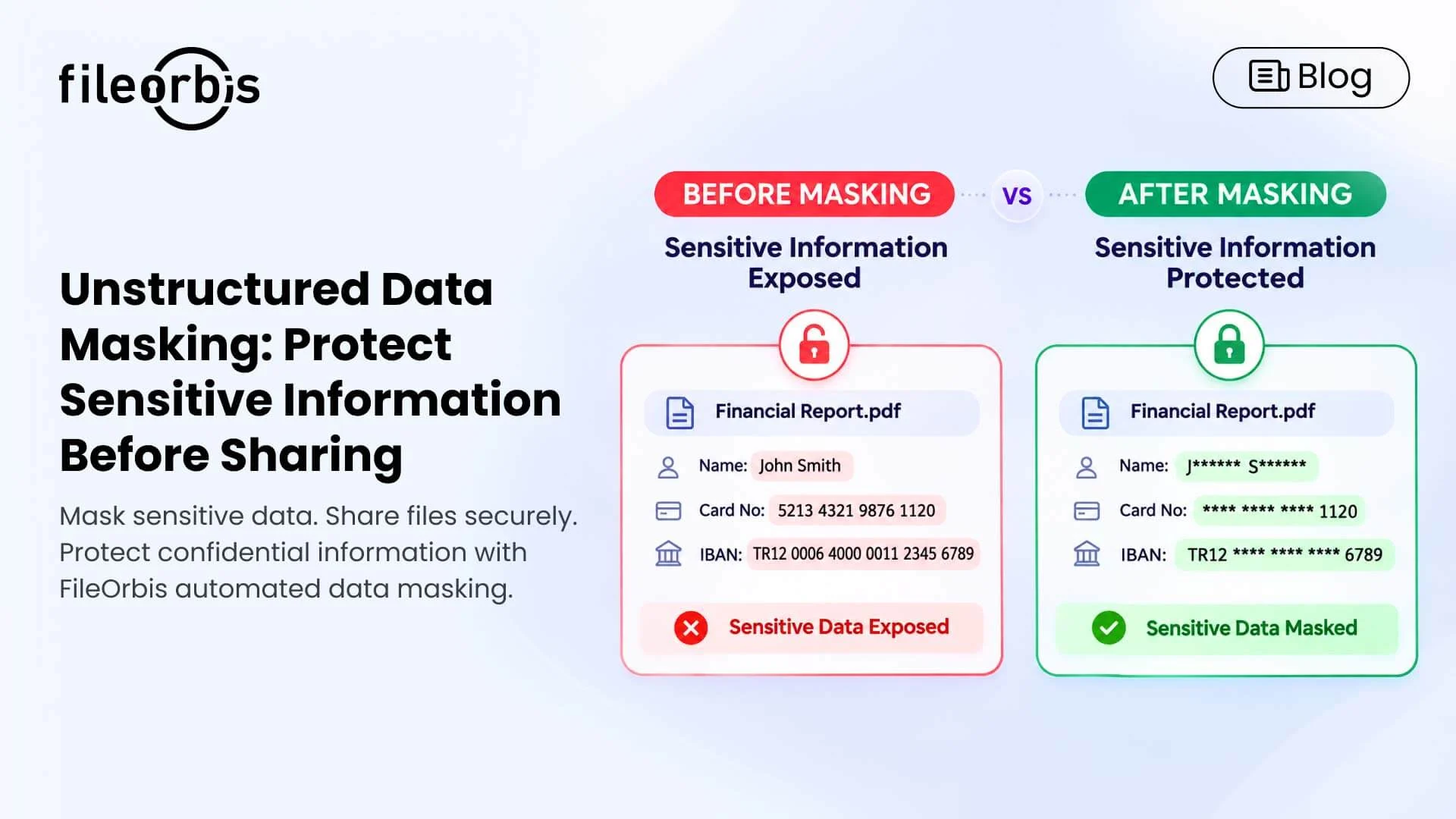
Unstructured Data Masking: Protect Sensitive Information Before Sharing
Enterprise files often contain sensitive information that organizations may not immediately recognize. Unstructured data masking helps protect personal identifiers, confidential business information, and regulated data found in contracts, financial reports, employee records, and customer documents.
Traditional access controls determine who can access a document, but they don’t necessarily control what information within it can be disclosed.
By concealing sensitive information within files, unstructured data masking allows organizations to share necessary content without exposing confidential details.
What is Unstructured Data Masking?
Unstructured data masking is the process of detecting and obscuring sensitive information within PDFs, documents, spreadsheets, and other enterprise files.
Unlike structured data masking, which operates on predefined database fields, it identifies sensitive information embedded within different document formats and contexts.
Common examples include:
- Personally Identifiable Information (PII): National identification numbers, personal identifiers, and contact details.
- Financial Information: Credit card numbers, IBANs, and bank account details.
- Confidential Business Data: Contract references, proprietary information, and internal identifiers.
- Protected Health Information (PHI): Patient identifiers and sensitive medical information.
For example, masking can conceal selected digits of a bank account number while keeping the remaining document usable.
The Importance of Unstructured Data Masking for Enterprise Security
Sensitive information is distributed across file servers, NAS devices, cloud storage, and collaboration platforms. When files are shared externally, several challenges arise:
- Manual Redaction: Manually reviewing and removing confidential information is time-consuming, difficult to scale, and prone to human error.
- Limited Content Visibility: File permissions don’t identify sensitive information within documents, increasing the risk of accidental disclosure.
- Regulatory Requirements: HIPAA, GDPR, and other applicable regulations require appropriate safeguards for sensitive information. Masking can support data minimization and protection objectives.
How Unstructured Data Masking Works
Effective unstructured data masking combines content inspection, sensitive data detection, and policy-based enforcement.
A typical workflow includes four steps:
- Content Inspection: Analyze supported file formats to identify potentially sensitive information.
- Sensitive Data Detection: Recognize confidential data using predefined patterns, custom rules, and classification metadata.
- Automated Masking: Conceal selected sensitive values according to organizational security policies.
- Policy Enforcement: Apply sharing controls, including approval requirements or blocking, depending on the file content and context.
This approach helps organizations protect specific information within documents rather than restricting access to entire files.
How FileOrbis Helps
FileOrbis helps organizations protect sensitive enterprise information through real-time content inspection and policy-driven security controls.
Key capabilities include:
- Real-Time Content Inspection: Analyze files during supported upload, editing, and download operations.
- Automated Sensitive Data Masking: Detect and mask PII, financial identifiers, and other defined sensitive data patterns.
- Classification-Aware Policies: Integrate with Microsoft Purview, Titus, and MIP classification labels.
- OCR-Based Inspection: Identify sensitive information within supported images and scanned PDFs.
- Custom Detection Rules: Use predefined patterns, proprietary data groups, and regular expressions.
- Centralized Governance: Apply consistent controls across supported file servers, NAS, and cloud storage environments without requiring data migration.
- Policy-Based Enforcement: Apply masking, approval workflows, watermarking, or blocking according to organizational policies.
For example, when an employee shares a financial document with an external partner, FileOrbis can identify sensitive account information and apply the configured masking or approval policy before delivery.
In Summary
Protecting sensitive information shouldn’t mean restricting access to all documents or slowing down collaboration. Unstructured data masking allows organizations to hide confidential details while ensuring business-critical information remains accessible and usable.
By combining automated masking with content-focused security controls, support compliance requirements, organizations can reduce accidental data exposure, and share corporate files more securely.
FileOrbis Content Aware Sharing brings these controls into existing file workflows, helping organizations protect sensitive information without compromising productivity.
Explore FileOrbis Content Aware Sharing.
Frequently Asked Questions
- What is the difference between data masking and encryption?
Encryption makes data unreadable without the appropriate decryption mechanism, while masking hides selected sensitive information while keeping the remaining content usable.
- Can unstructured data masking be automated?
Yes. Automated content inspection and policy-based enforcement can identify and mask sensitive information in supported file formats, reducing manual effort and the risk of data exposure.
- How does FileOrbis support unstructured data masking?
FileOrbis Content Aware Sharing combines automated sensitive data masking, real-time content inspection, and policy-based enforcement to protect confidential information during file sharing. It helps organizations control sensitive data exposure without disrupting collaboration.

Hammam Abunaser
Sales Director, MEA
Subscribe to our Newsletter
About FileOrbis
Aiming to manage the user and file relationship within an institutional framework, FileOrbis is constantly being developed in order to meet different industry and customer needs in terms of file management and sharing. Since 2018, FileOrbis continues to be developed with the excitement of the first day. FileOrbis focuses on high security, rich integration, ease of use and integrated management criteria.