
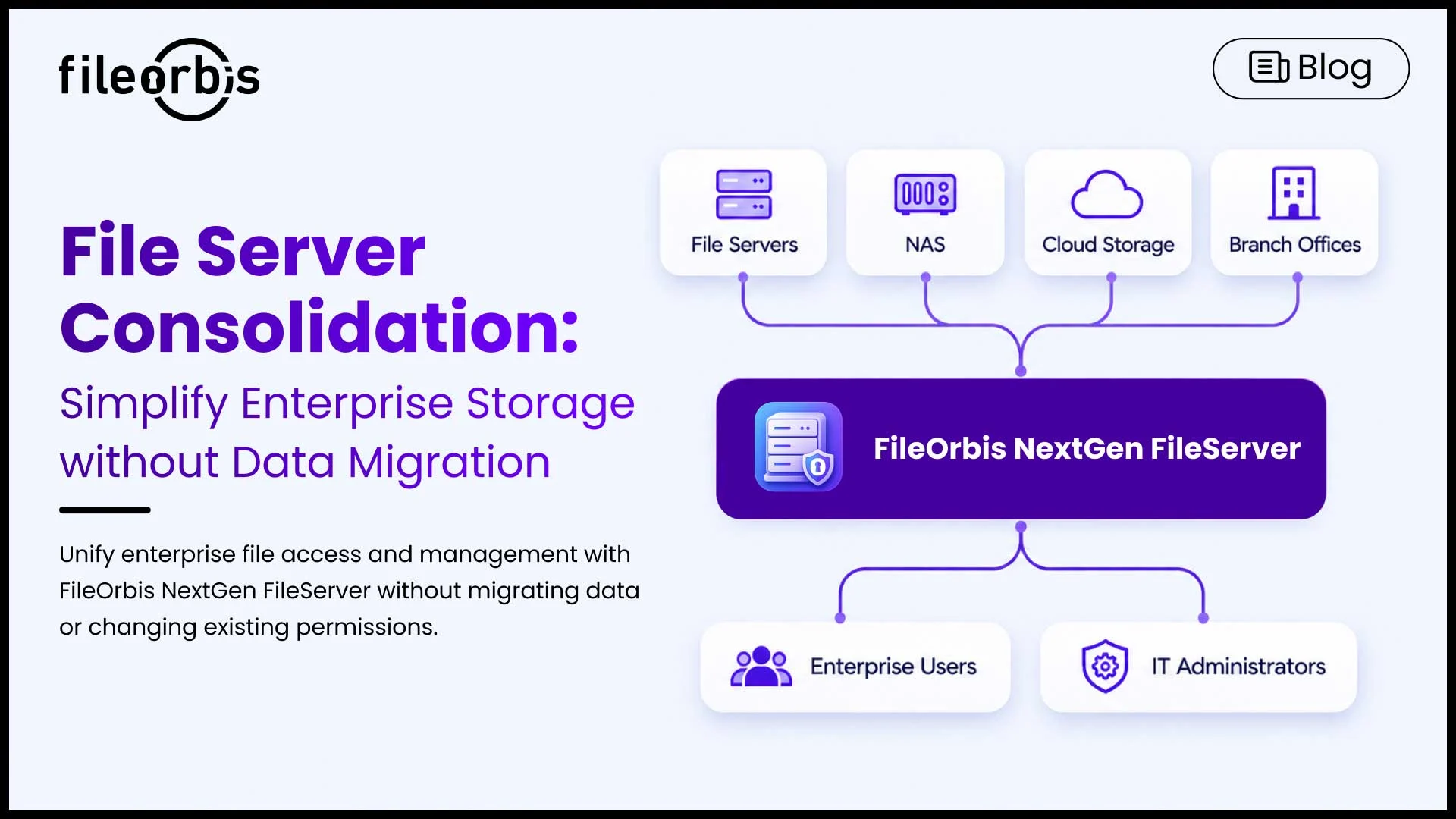
File Server Consolidation: Simplify Enterprise Storage without Data Migration
Enterprise file environments often expand across multiple servers, NAS devices, branch offices, and cloud storage systems. As infrastructure becomes more distributed, file server consolidation helps organizations simplify storage management, improve file access, and reduce administrative complexity.
However, consolidation doesn’t always require data migration or changing existing infrastructure. Through file system federation, businesses can connect existing repositories under a unified access layer while keeping files in their original locations.
What is File Server Consolidation?
File server consolidation is the process of simplifying distributed file infrastructure by centralizing access, management, or storage resources.
There are two primary approaches:
- Logical Consolidation: Connecting existing file servers and repositories through a unified access layer without relocating data.
- Physical Consolidation: Migrating files and workloads to fewer storage systems to reduce infrastructure requirements.
Logical consolidation is particularly useful for enterprises managing hybrid storage environments where replacing existing systems is impractical.
Why Traditional File Server Consolidation is Challenging
Traditional consolidation projects involve more than transferring files between servers.
Common challenges include:
- Permission Dependencies: Existing Active Directory and NTFS permissions must remain consistent.
- Application Dependencies: Business applications may rely on specific file paths and network shares.
- Data Migration Complexity: Moving large file volumes can disrupt business operations.
- Storage Compatibility: Different protocols and storage technologies complicate integration.
- Distributed Infrastructure: Remote offices may require local file access for performance.
These dependencies can increase project costs, introduce operational risks, and extend implementation timelines.
How File Server Consolidation Works without Migration
File system federation offers an alternative to migration-based consolidation.
Instead of transferring files into a central repository, federation connects existing storage systems and presents them through a unified file structure.
This approach allows organizations to:
- Connect Distributed Repositories: Integrate file servers, NAS, and cloud storage.
- Preserve Existing Permissions: Maintain established identity and access controls.
- Simplify File Access: Ensure consistent access across different storage locations.
- Centralize Management: Reduce administrative effort across independent systems.
- Protect Storage Investments: Continue using existing infrastructure.
Unlike physical consolidation, federation does not automatically eliminate server or storage costs. Instead, it simplifies management and creates opportunities for infrastructure optimization.
Key Benefits of Enterprise File Server Consolidation
Simplified Access and Permission Management
Managing independent file servers increases administrative complexity, especially when permissions differ across departments and storage locations.
A unified management layer helps IT teams maintain visibility into file access and manage permissions more consistently.
Greater Flexibility Across Hybrid Storage
Enterprises frequently operate Windows file servers alongside NAS, object storage, and cloud storage.
Logical consolidation allows these environments to remain connected without requiring organizations to standardize every repository on the same technology.
Reducing Branch Office Dependencies
Remote offices often maintain local file servers to provide faster access to frequently used documents.
Edge caching can improve access performance by keeping frequently requested files closer to users, reducing dependence on dedicated branch infrastructure.
How FileOrbis Helps
FileOrbis NextGen FileServer helps enterprises unify file access and management across existing storage infrastructures without mandatory data migration.
Its capabilities include:
- Unified Permission Management: Manage access while preserving existing AD/NTFS permissions.
- Multi-Protocol File Federation: Connect Windows file servers, NAS, NFS, SharePoint, OneDrive, SFTP, and S3-compatible storage.
- FileOrbis Edge Cache: Improve access to frequently used files at remote locations.
- Virtual Drive Access: Access distributed files through a unified drive without full synchronization.
- Secure Remote Access: Enable HTTPS-based file access with MFA and policy-based controls.
- Centralized Auditing: Monitor file activities across connected environments.
By separating file access from physical storage locations, FileOrbis helps organizations modernize their file infrastructure while retaining existing systems and access controls.
In Summary
File server consolidation no longer needs to be entirely dependent on large-scale data migration.
Through logical consolidation and file system federation, businesses can simplify distributed storage management, preserve existing permissions, and progressively optimize infrastructure.
FileOrbis NextGen FileServer helps this approach by connecting existing file environments through a unified access and management layer.
Frequently Asked Questions
What is the difference between file server consolidation and migration?
File server consolidation simplifies distributed file infrastructure, while migration physically transfers data between storage systems. Logical consolidation can connect existing repositories together without moving files.
Can file server consolidation improve remote office performance?
Yes. Edge caching can accelerate access to frequently used files and reduce reliance on dedicated branch file servers.
How can enterprises consolidate file servers without moving data?
File system federation connects existing repositories through a unified access layer. FileOrbis NextGen FileServer helps this approach while preserving existing storage locations and access permissions.

Faris Suleiman
Presales Manager, KSA & Egypt
Subscribe to our Newsletter
About FileOrbis
Aiming to manage the user and file relationship within an institutional framework, FileOrbis is constantly being developed in order to meet different industry and customer needs in terms of file management and sharing. Since 2018, FileOrbis continues to be developed with the excitement of the first day. FileOrbis focuses on high security, rich integration, ease of use and integrated management criteria.