
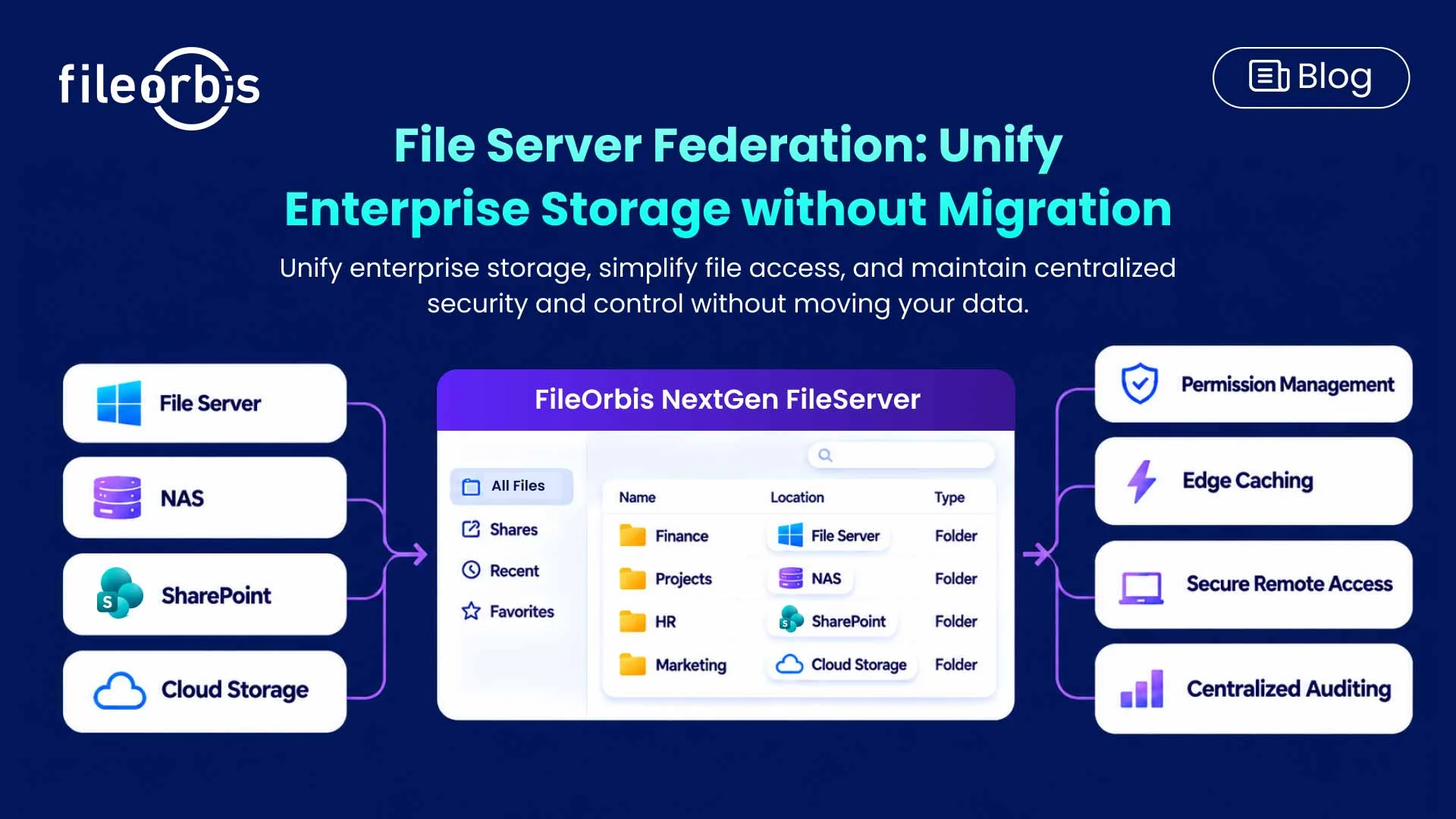
File Server Federation: Unify Enterprise Storage without Migration
Enterprise file environments often include Windows file servers, NAS devices, cloud storage, and SharePoint repositories distributed across departments and locations. Managing these systems separately increases administrative complexity, fragments file access, and makes consistent management difficult. File server federation enables organizations to modernize their file infrastructure without migrating data by connecting existing storage systems through a unified access layer.
What is File Server Federation?
This approach connects multiple storage locations into a single logical file environment while keeping data in their original locations.
Unlike storage consolidation, federation provides unified access across independent systems.
A typical federation architecture includes:
- Multi-Protocol Connectivity: Connect file servers, NAS devices, and cloud storage.
- Access Control Integration: Work with existing identity and permission systems.
- Unified Namespace: Present distributed files through a consistent access structure.
- Centralized Management: Manage connected storage through a common interface.
Why Enterprises Need File Server Federation
Business expansion, acquisitions, and cloud adoption often introduce new storage environments, creating operational and security challenges.
Common challenges include:
- Fragmented File Access: Employees navigate multiple repositories to locate documents.
- Administrative Overhead: IT teams manage separate storage interfaces and configurations.
- Legacy Infrastructure Limitations: Traditional file servers may lack modern remote access and collaboration capabilities.
- Limited Visibility: Distributed file activity makes security monitoring and auditing difficult.
How File Server Federation Works
A federated architecture creates a logical access layer between users and distributed storage.
There are three components that support this architecture:
Storage Connectivity
Connectors and supported protocols enable communication with existing file servers, NAS systems, and cloud storage.
Unified File Access
A shared interface or virtual drive allows users to work with files on connected storage.
Access Control Integration
The federation layer coordinates authentication and file operations with the underlying identity and storage systems, respecting existing permissions.
Key Benefits of a Federated File Infrastructure
Beyond simplifying storage connectivity, file server federation offers practical advantages for enterprise IT operations:
- Reduced Migration Costs: Avoid unnecessary data transfers and minimize infrastructure migration expenses.
- Lower Operational Complexity: Simplify management across distributed storage systems.
- Improved Employee Productivity: Reduce time spent navigating disconnected file environments.
- Greater Hybrid Flexibility: Adapt to changing on-premises and cloud storage requirements.
- Extended Infrastructure Lifespan: Continue using your existing storage investments while delivering modern capabilities.
File Server Federation vs. File Server Migration
While both approaches support infrastructure modernization, they serve different purposes.
- File server federation connects repositories while maintaining existing storage locations.
- File server migration transfers files to a new storage environment and may require changes to file paths, workflows, and permissions.
Federation is useful when organizations want to preserve infrastructure and minimize disruptions. Migration is more appropriate when retiring legacy systems or consolidating storage.
Both approaches can support a phased modernization strategy.
How FileOrbis Helps
FileOrbis NextGen FileServer provides a centralized federation and management layer for enterprise storage environments.
Capabilities include:
- Multi-Protocol Federation: Connect Windows file servers, NAS, NFS, S3 compliant storage, FTP/SFTP, Azure Blob, and SharePoint repositories.
- Permission Management: Integrate with Active Directory and existing NTFS permissions while providing centralized management.
- Edge Caching: Improve access performance for frequently used files in distributed locations.
- Unified Virtual Drive: Provide consistent file access with on-demand streaming.
- Secure Remote Access: Provide HTTPS-based connectivity without traditional SMB-over-VPN access.
- Centralized Auditing: Monitor file activity and support enterprise security monitoring integrations.
FileOrbis enables organizations to extend their existing infrastructure with modern file access, management, and governance capabilities.
In Summary
This approach helps businesses simplify distributed storage management without needing to completely replace their infrastructure.
When evaluating federation solutions, organizations should prioritize storage compliance, access performance, permission protection, and centralized visibility.
FileOrbis NextGen FileServer combines these capabilities to support secure file operations in hybrid environments.
Explore FileOrbis NextGen FileServer to learn more about enterprise file server federation.
Frequently Asked Questions
What is the difference between file server federation and storage consolidation?
File server federation connects multiple storage systems through a unified access layer without relocating the data. Storage consolidation moves data to fewer storage systems to simplify infrastructure.
Can file server federation work across on-premises and cloud storage environments?
Yes. Federation solutions provide consistent file access in hybrid environments by connecting on-premises file servers, NAS devices, and supported cloud storage.
How does FileOrbis help with file server federation?
FileOrbis NextGen FileServer unifies distributed storage without data migration, providing centralized permission management, edge caching, secure remote access, and auditing while preserving existing infrastructure.

Faris Suleiman
Presales Manager, KSA & Egypt
Subscribe to our Newsletter
About FileOrbis
Aiming to manage the user and file relationship within an institutional framework, FileOrbis is constantly being developed in order to meet different industry and customer needs in terms of file management and sharing. Since 2018, FileOrbis continues to be developed with the excitement of the first day. FileOrbis focuses on high security, rich integration, ease of use and integrated management criteria.