
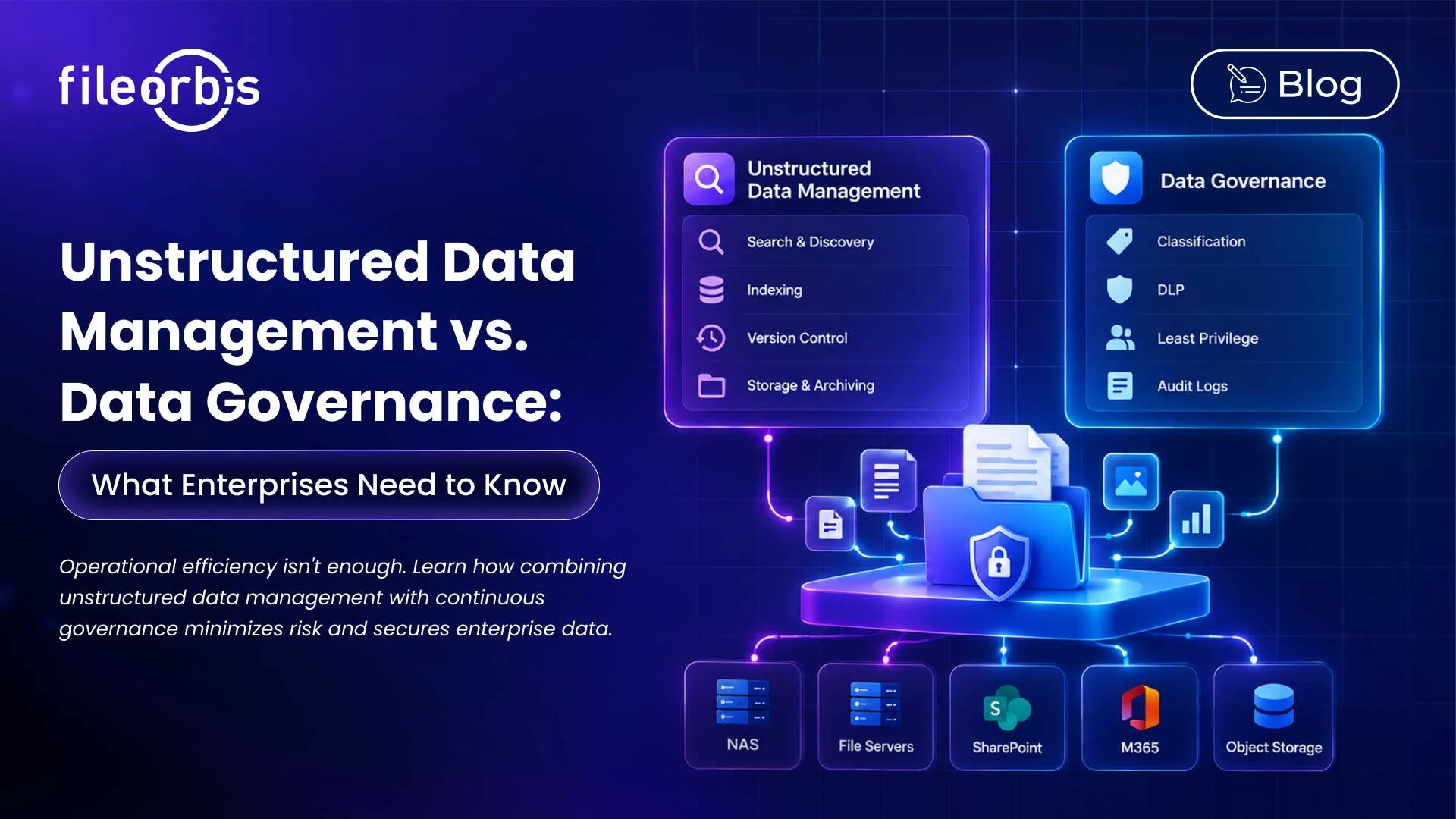
Unstructured Data Management vs. Data Governance: What Enterprises Need to Know
Enterprise files are distributed across file servers, NAS systems, SharePoint, M365, cloud storage, and hybrid environments. Managing this growing volume of unstructured data requires more than just keeping files accessible and organized.
Unstructured data management focuses on ensuring files are accessible, operational, and searchable. Data governance goes further by determining whether these files are properly accessed, stored, maintained, shared, and protected.
Enterprises need both. One supports efficient file processing, while the other provides the controls needed to manage risk, accountability, and compliance.
What is Unstructured Data Management?
Unstructured data management covers the daily processes and technologies used to organize, protect, access, and manage enterprise files throughout their lifecycle.
Typical capabilities include:
- Enterprise search and content discovery
- File storage and repository management
- Version management
- Metadata and document organization
- File access and availability
- Remote and hybrid file access
- Archiving and lifecycle operations
- Storage optimization
The main question is:
“Can users efficiently find, access, and work with the files they need?”
These capabilities are important, but they do not necessarily determine whether access, storage, sharing, or retention is appropriate from a security or compliance standpoint.
What Is Unstructured Data Governance?
Unstructured data governance adds policies, ownership, security context, and accountability to file management.
Instead of asking whether a file is accessible, governance asks these questions:
- What sensitive information does the file contain?
- Who has access?
- Are the permissions excessively broad?
- Who owns the file?
- Can the file be shared externally?
- Is it stored in an approved location?
- How long should it be stored?
- Are governance actions traceable?
- Can enterprise AI or RAG systems access it?
This shifts the focus from managing files to controlling how enterprise information is used over time.
Unstructured Data Management vs. Data Governance
Although these two disciplines overlap, their priorities differ.
- Primary Goal: Unstructured data management focuses on availability and operational efficiency. Data governance focuses on reducing risk, ensuring accountability, and supporting compliance.
- Scope: Management covers storage, search, access, versioning, archiving, and lifecycle operations. Governance includes classification, permissions, policy enforcement, retention, risk, and auditability.
- Stakeholders: File operations are typically managed by IT, infrastructure, and collaboration teams. Security, GRC, compliance, legal, and data owners have a greater say in governance decisions.
- Controls: Management relies on capabilities such as search, metadata, archiving, and version management. Governance adds classification, least privileged access, sharing controls, DLP, policy enforcement, and audit logging.
- Outcomes: Management improves file accessibility and operational efficiency. Governance helps reduce over access, inappropriate storage, sensitive data exposure, and uncontrolled sharing.
- KPIs: Management can track availability, search performance, storage usage, and access performance. Governance can track excessive permissions, disclosure of sensitive data, policy violations, risks of external sharing, and remediation status.
Therefore, an environment can be well managed even without being well-governed.
For example, a document might be searchable, backed up, correctly versioned, and highly available while still containing sensitive information that is accessible to too many users or stored in an inappropriate location.
Why Enterprises Need Both in One Operating Model
Treating management and governance as separate initiatives can create gaps between operational visibility and security action.
A stronger operating model connects them through an ongoing process:
- Discover files across enterprise repositories.
- Classify content by sensitivity and business context.
- Assess permissions, ownership, location, sharing, and risk.
- Enforce policies for access, sharing, DLP, retention, and location.
- Remediate over access, inappropriate storage, and other identified risks.
- Monitor and audit file activity, governance actions, and policy violations.
This model allows organizations to keep files accessible while applying consistent controls based on content, business requirements, and permissions.
It also helps security and IT teams work within the same data context instead of maintaining separate operational and governance processes.
How FileOrbis Helps
FileOrbis brings together file management and governance capabilities across existing enterprise file environments.
Organizations can use FileOrbis for the following:
- Enable unified access and search across distributed file environments
- Discover sensitive information in corporate files
- Apply AI-based classification and sensitivity context
- Analyze permissions and identify over access
- Control external sharing and sensitive data movement
- Enforce content-aware and permission-aware policies
- Remediate identified file risks
- Enforce lifecycle and retention policies
- Maintain an audit log for file and governance activities
- Extend permission-aware controls to enterprise AI and RAG
FileOrbis works across existing file servers, NAS, SharePoint, M365, and cloud environments, enabling organizations to manage data where it already is, without the need for a large-scale repository migration.
As a result, enterprises can connect daily unstructured data management with continuous governance, policy enforcement, and risk reduction.
In Summary
Unstructured data management and data governance address different but related problems.
Management keeps corporate files organized, accessible, operational, and searchable. Governance determines whether these files are accessed, retained, stored, shared, and used in accordance with organizational policies.
Organizations need both capabilities to work together. By combining file operations with classification, permission analysis, remediation, policy enforcement, and auditability, organizations can maintain productivity while reducing the risk of unstructured data.
Frequently Asked Questions
What is unstructured data management?
Unstructured data management is the process of organizing, accessing, storing, searching, and maintaining corporate files throughout their lifecycle.
What is the difference between unstructured data management and data governance?
Unstructured data management focuses on file availability and processing. Data governance, on the other hand, adds policies and controls for sensitivity, permissions, retention, sharing, risk, and accountability.
Why do enterprises need both?
Management ensures that files are available and accessible, while governance ensures that their use is controlled and compliant with security, business policies, and compliance.

Hammam Abunaser
Sales Director, MEA
Subscribe to our Newsletter
About FileOrbis
Aiming to manage the user and file relationship within an institutional framework, FileOrbis is constantly being developed in order to meet different industry and customer needs in terms of file management and sharing. Since 2018, FileOrbis continues to be developed with the excitement of the first day. FileOrbis focuses on high security, rich integration, ease of use and integrated management criteria.