
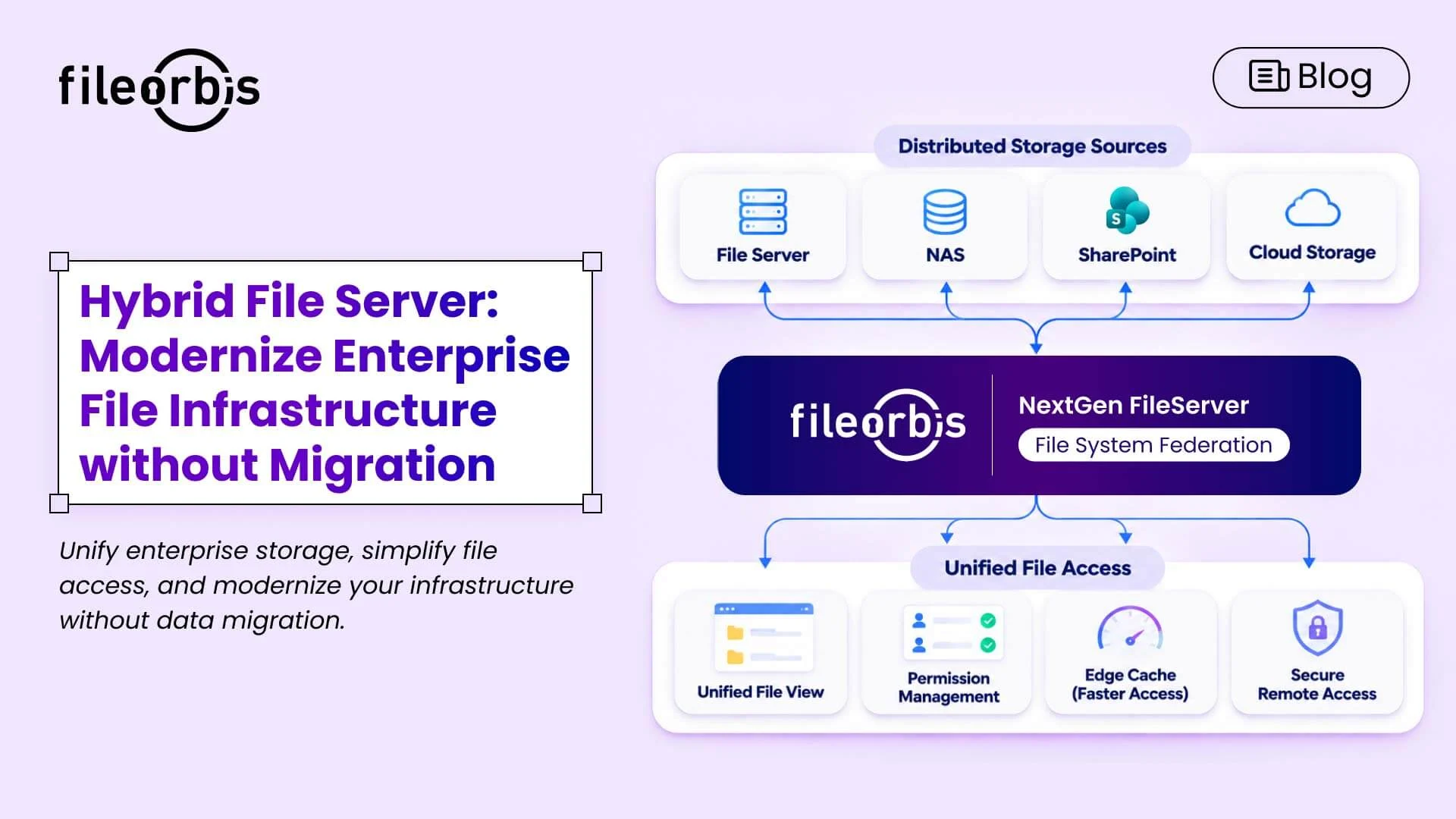
Hybrid File Server: Modernize Enterprise File Infrastructure without Migration
Enterprise files are distributed across Windows file servers, NAS systems, cloud storage, and remote offices. As organizations adopt hybrid environments, a hybrid file server helps address the administrative complexity, accessibility limitations, and performance challenges associated with managing these systems separately.
A hybrid file server connects existing storage systems through a unified file management architecture, allowing organizations to modernize file infrastructure without replacing their current storage investments.
What is Hybrid File Server?
A hybrid file server combines on-premises file infrastructure with cloud and object storage, allowing users to access files in different repositories through a common interface.
Key capabilities include:
- File System Federation: Connect multiple storage repositories without consolidating their contents.
- Centralized Administration: Simplify file access and management across locations.
- Storage Flexibility: Maintain files across on-premises and cloud environments.
- Remote Accessibility: Support distributed teams without exposing internal file servers directly.
Why Traditional File Servers Struggle in Hybrid Environments
Traditional file servers remain important for enterprise operations, but distributed environments introduce several limitations:
- Complex Administration: IT teams maintain different access methods and management processes.
- Fragmented Storage: Employees must navigate separate repositories to locate files.
- Remote Access Dependencies: Traditional network-based access can create connectivity and usability challenges.
- Infrastructure Modernization Costs: Replacing legacy systems may require extensive migration planning and operational downtime.
- WAN Performance Limitations: Large files may load slowly in geographically distributed locations.
Key Benefits of a Hybrid File Server
- File System Federation Across Storage Environments
File system federation connects different storage repositories through a unified file structure.
Employees can access enterprise files without navigating separate storage systems or knowing where individual documents are physically stored.
This approach helps organizations:
- Simplify access to distributed enterprise data.
- Reduce fragmented file environments.
- Support collaboration across different storage platforms.
- File Server Modernization without Migration
Replacing existing file infrastructure often requires transferring large datasets, changing established workflows, and rebuilding permissions.
A hybrid file server can provide a modern access layer over existing storage, reducing the need for disruptive migration projects.
Organizations can extend their current infrastructure while introducing new file management capabilities incrementally.
- Centralized Access and Permission Management
Managing permissions across multiple storage environments increases administrative complexity and can create inconsistent access controls.
Centralized permission management helps IT teams maintain visibility into file access while integrating with existing identity systems.
This supports simplified administration, more consistent authorization, and improved oversight across distributed repositories.
- Improved Remote File Access and Performance
Distributed enterprises frequently experience delays when accessing large files across wide-area networks.
Hybrid file server solutions can use edge caching to store frequently accessed content closer to remote users.
This helps organizations:
- Accelerate access to frequently used files.
- Reduce latency between offices and central storage.
- Minimize repeated data transfers across WAN connections.
How FileOrbis Helps
FileOrbis NextGen FileServer extends existing enterprise file infrastructure with modern access, management, and performance capabilities.
Its key capabilities include:
- File System Federation: Connect Windows file servers, NAS, NFS, S3, SharePoint, Azure Blob, and SFTP repositories through a unified file structure.
- Unified Permission Management: Manage access centrally while respecting existing Active Directory and NTFS permissions.
- Edge Cache: Improve file performance for remote offices and distributed teams.
- Virtual Drive: Provide on-demand file access with local caching through a familiar drive interface.
- Secure Remote Access: Enable controlled HTTPS-based file access without requiring traditional VPN connectivity.
- File Governance: Enforce security policies and maintain audit visibility across connected repositories.
By extending existing storage rather than replacing it, FileOrbis helps enterprises modernize file operations while reducing migration requirements and infrastructure disruption.
In Summary
A hybrid file server provides a practical way to modernize enterprise file infrastructure. It brings together distributed storage environments, improves file accessibility, and supports more efficient administration.
With FileOrbis NextGen FileServer, organizations can introduce modern file management capabilities while continuing to use their existing on-promises and cloud storage.
Learn more about NextGen FileServer.
Frequently Asked Questions
- What is the difference between a traditional file server and a hybrid file server?
A traditional file server typically provides access to files on a specific storage environment. A hybrid file server connects multiple on-premises and cloud repositories through a common access layer.
- Does hybrid file server modernization require data migration?
Not necessarily. File system federation allows organizations to connect existing storage repositories without transferring all files into a new platform.
- How does FileOrbis support hybrid file server modernization?
FileOrbis NextGen FileServer combines file system federation, Virtual Drive access, centralized permission management, Edge Cache, and secure remote access to modernize existing enterprise file environments.

Gamze Mat
Product Manager
Subscribe to our Newsletter
About FileOrbis
Aiming to manage the user and file relationship within an institutional framework, FileOrbis is constantly being developed in order to meet different industry and customer needs in terms of file management and sharing. Since 2018, FileOrbis continues to be developed with the excitement of the first day. FileOrbis focuses on high security, rich integration, ease of use and integrated management criteria.